
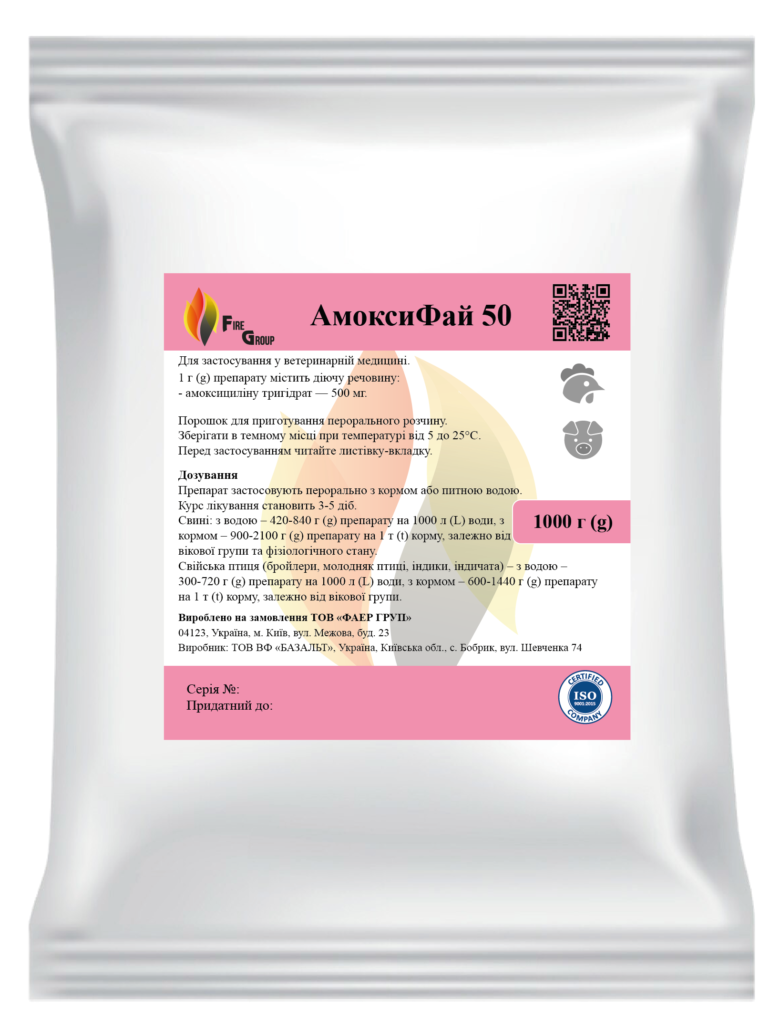
Amoxifay 50
- Composition:
- 1 g of the drug contains the active ingredient: Amoxicillin (in the form of trihydrate) - 500 mg. Excipients: sodium carbonate, dextrose, silicon dioxide.
- Pharmaceutical form: powder for oral solution.
- Shelf life: 2 years. After first removal from the packaging, the product must be used within 10 days. After dissolving the product in drinking water, the shelf life is 24 hours, and after mixing with liquid feed, it is 4 hours.
- Special storage precautions: Store in a dry, dark place out of reach of children at a temperature of 10 to 25 °C.
- Packaging: 1000 g polyethylene film bags.
- РП №АВ-10001-01-26
- Manufacturer: Fire Group, Ukraine.
Amoxifay 50
Pharmacological properties:
ATC vet classification code QJ01 – antibacterial veterinary drugs for systemic use. QJ01CA04 – Amoxicillin.
Amoxicillin is a beta-lactam antibiotic from the group of semi-synthetic penicillins (aminopenicillins). Its mechanism of action is to disrupt the synthesis of the bacterial cell wall by inhibiting the enzymes transpeptidase and carboxypeptidase, which leads to osmotic imbalance and death of the bacterial cell in the phase of active growth. Amoxicillin is active against gram-positive (Clostridium spp., Corynebacterium spp., Bacillus anthracis, Listeria monocytogenes, Staphylococcus spp., Streptococcus spp.) and gram-negative (Actinobacillus spp., Escherichia coli, Fusobacterium spp., Haemophilus spp., Moraxella spp., Pasteurella spp., Salmonella spp., Klebsiella spp.) microorganisms.
Amoxicillin is well absorbed after oral administration and is stable in the presence of gastric acid. Amoxicillin is well distributed in body fluids and tissues. Particularly high concentrations are observed in the kidneys. The bioavailability of amoxicillin is 65-93 %.
When amoxicillin was administered orally to pigs at a dose of 20 mg/kg body weight per day for 5 days, its maximum concentration in blood plasma was 2.2 μg/ml and was reached 1.5 hours after administration. Repeated administration of amoxicillin does not lead to its accumulation.
When amoxicillin is administered orally to chickens at a dose of 20 mg/kg body weight per day for 5 days, its plasma concentrations range from 0.03 to 0.2 μg/ml. Repeated use of amoxicillin does not lead to its accumulation.
Amoxicillin is excreted primarily by the kidneys, mainly unchanged by tubular secretion, but a small part of it is metabolized by hydrolysis to inactive penicillic acid, which is excreted in the urine.
Clinical features
Animal species
Pigs and poultry (broiler chickens).
Indications for use
Pigs: treatment of animals for respiratory diseases (caused by Actinobacillus pleuropneumoniae, Pasteurella spp. and Haemophilus spp.), of the genitourinary system caused by microorganisms sensitive to amoxicillin.
Poultry (broiler chickens): treatment of poultry for respiratory diseases caused by microorganisms (E. coli, Pasteurella spp. and Haemophilus spp.), sensitive to amoxicillin.
Contraindication
Do not use in animals with known hypersensitivity to penicillins and other beta-lactams.
Do not use the drug on rabbits, guinea pigs, hamsters or other small herbivorous animals.
Do not use in animals with severe renal impairment, including anuria and oliguria.
Do not use if the identified pathogen is resistant to penicillins and other beta-lactams.
Do not use in ruminants and horses.
Do not use in laying hens whose eggs are used for human consumption.
Do not use concomitantly with neomycin, as it blocks the absorption of orally administered penicillins, as well as with bacteriostatic antimicrobials.
Side effect
Penicillins and cephalosporins can cause hypersensitivity reactions.
Special precautions for use
The use of the drug should be based on the determination of the susceptibility of bacteria isolated from diseased animals to amoxicillin. If this is not possible, therapy should be based on local (regional, farm) epizootic information on the susceptibility of the target bacteria.
Use of the drug deviating from the indications for use given in the SPC may increase the prevalence of bacteria resistant to amoxicillin and may reduce its therapeutic efficacy and the effectiveness of treatment with other penicillins due to possible cross-resistance.
Use during pregnancy, lactation, and egg production
Studies conducted on laboratory animals have not shown any teratogenic, embryotoxic effects or toxic effects on the maternal organism.
The safety of the product has not been studied in pregnant or lactating sows. The product should only be used after a benefit/risk assessment by a veterinarian.
Do not use in laying hens whose eggs are used for human consumption.
Interaction with other means and other forms of interaction
Do not use concomitantly with neomycin, as it blocks the absorption of orally administered penicillins, as well as with bacteriostatic antimicrobials.
Doses and methods of administration to animals of different ages
Orally with drinking water (broiler chickens, pigs) or liquid feed (pigs) at a dose of 20 mg of amoxicillin (in the form of trihydrate) per 1 kg of body weight (equivalent to 400 mg of the drug per 10 kg of body weight) daily for 5 days.
Pigs: The drug must first be diluted in a small amount of water and mixed well, then the resulting solution must be diluted in drinking water or liquid feed to achieve uniformity.
Broilers: gradual addition to drinking water. The drug must first be diluted in a small amount of water, then the resulting solution is diluted in a container with drinking water and mixed. Shut off the water supply to the tank until all the medicinal solution is used up. This dilution process ensures better homogeneity of the final solution. The concentrated solution can also be supplied through water dispensers.
To ensure correct dosing, the weight of the animals to be treated should be determined as accurately as possible to avoid underdosing. Water consumption depends on the clinical condition of the animals and, in the case of chickens, also on the ambient or room temperature. To achieve the correct dosage, the concentration of amoxicillin should be adjusted according to the current water consumption. After the end of the drug administration, the water supply system should be properly cleaned to prevent the introduction of subtherapeutic amounts of the drug.
The calculated dose must be weighed using calibrated scales.
With stock solutions and when using a dosing pump, care must be taken not to exceed the maximum solubility achievable under the given conditions. The flow setting of the dosing pump must be adjusted according to the concentration of the stock solution and the current water consumption of the animals to be treated.
Overdose (symptoms, emergency measures, antidotes)
No side effects were observed after using the drug in doses 5 times higher than recommended.
Special precautions
None.
Withdrawal period (withdrawal period)
Pigs: meat and offal: 14 days.
Broilers: meat and offal*: 7 days.
* Meat obtained before the specified deadline is disposed of or fed to unproductive animals, depending on the conclusion of the veterinarian.
Special precautions for persons and service personnel
Allergic reactions are possible in people who are hypersensitive to amoxicillin. Irritation of the eyes, skin or respiratory tract is possible. Therefore, when working with the veterinary medicinal product and feed containing this product, direct contact with the eyes, skin and mucous membranes should be avoided and personal protective equipment should be worn. Hands should be washed after working with the product.
Similar products


Are you a veterinarian?
The information on this site is intended exclusively for veterinarians in accordance with Article 74 of the Law of Ukraine “On Veterinary Medicine” No. 1206-IX and Article 21 of the Law of Ukraine “On Advertising” No. 270/96-VR